

I cannot believe that it is already the last recipe for our January culinary excursion! For this final January recipe, I thought I would leave you with something particularly gut-loving: This Homemade Sauerkraut.

If you are now thinking: “There is no chance in hell I am going to make Sauerkraut, it is far too complicated a process”…. Be prepared to be swayed. Making your own Sauerkraut is actually super easy, does not require a huge amount of time and will leave you with something that tastes utterly delicious. The store-bought version cannot hold up to this homemade delight. Besides, once you know what you are doing, you can add all kinds of combinations of flavor. For example, I added grated carrot, garlic, and fennel to this version.

Why is this Homemade Sauerkraut good for me?
Instead of talking about the ingredients in and on-itself, I thought I would dive a bit deeper into why this Homemade Sauerkraut and fermented foods, in general, are good for us. First of all – what is fermentation? Fermentation is an ancient process through which food was being preserved. Yeast or bacteria usually kick off the fermentation process and turn starches, carbohydrates, or sugar into alcohol and acids. The alcohol and/or acid are also the reason for the slightly sour taste that you usually get with fermented foods.
During the fermentation process, bacteria develop. These bacteria are called “probiotics” and are highly beneficial for our gut health. A healthy gut is linked to overall immunity. In recent years, there has been an increasing amount of research to also explore the brain-gut connection. This means that stress and anxiety can potentially lead to an upset tummy, even if you have not eaten something that may cause you discomfort. But it can also be the other way around – for example, have you ever experienced your tummy being unwell and your brain feeling really tired, sluggish and foggy (I know I have! 🙋🏼♀️) as a result of it? The probiotics in this Homemade Sauerkraut can help to restore gut-friendly bacteria in your digestive tract.
Fermentation also breaks down nutrients in their individual components. This makes them usually also a bit easier to digest and hence fermented foods can oftentimes also be consumed by people who have intolerances. A good example of this is lactose. Even if you are lactose intolerant, you may be able to eat quality, full-fat yogurt or kefir, as the lactose has already been broken down by the bacteria into its individual components.

Is there a difference between this Homemade Sauerkraut and the one I can buy at the supermarket?
Yes and no. This highly depends on what kind of Sauerkraut you are buying. In Germany, we eat a lot of Sauerkraut and you can easily pick it up in a can in the store. This is also the version that tends to get heated in Germany and is eaten with a piece of meat. This kind of kraut has been pasteurized in order to kill any potential bacteria and basically extend the shelf-life of the food. If you are picking up a tub of unpasteurized Sauerkraut then you will definitely get the benefits described above (unless you heat it). However, honestly, I find them to be quite expensive. The jars I make tend to last forever if you follow my simple tips below and are quite inexpensive in the making process 👇🏻😉.

Tips for making this Homemade Sauerkraut
- Ensure that you wash your chopping board, knife, and bowl before starting. I also cleaned my glass jar and then filled it once with hot water in order to kill any potentially harmful bacteria.
- Be sure to “burp” your glass regularly. The longer you ferment the Homemade Sauerkraut, the more sour the taste will become. Each day/stage in the fermentation process actually means slightly different bacteria. If you are turning into a Homemade Sauerkraut lover, you can easily stop fermenting (by putting it into the fridge) on different days to give your tummy a range of healthy gut bacteria.
- Once your kraut is fermented to your liking, put it into the fridge, which will significantly reduce/stop the fermenting process.
- Do ensure that you are always using a clean fork when digging out your kraut. It will last you a long time if you follow this step.

Finely cutting cabbage 
Leaving the stalk out of the kraut-making process 
Finely cut cabbage in bowl 
Added carrot, garlic, fennel seeds, and salt 
Started to massage – ca. 2 minutes. The cabbage starts to become wet 
Massaging for ca. 5 minutes. Cabbage is starting to collapse 
Massaging for 10 minutes. Cabbage has significantly reduced in size 
Water is pooling at the bottom of the cabbage 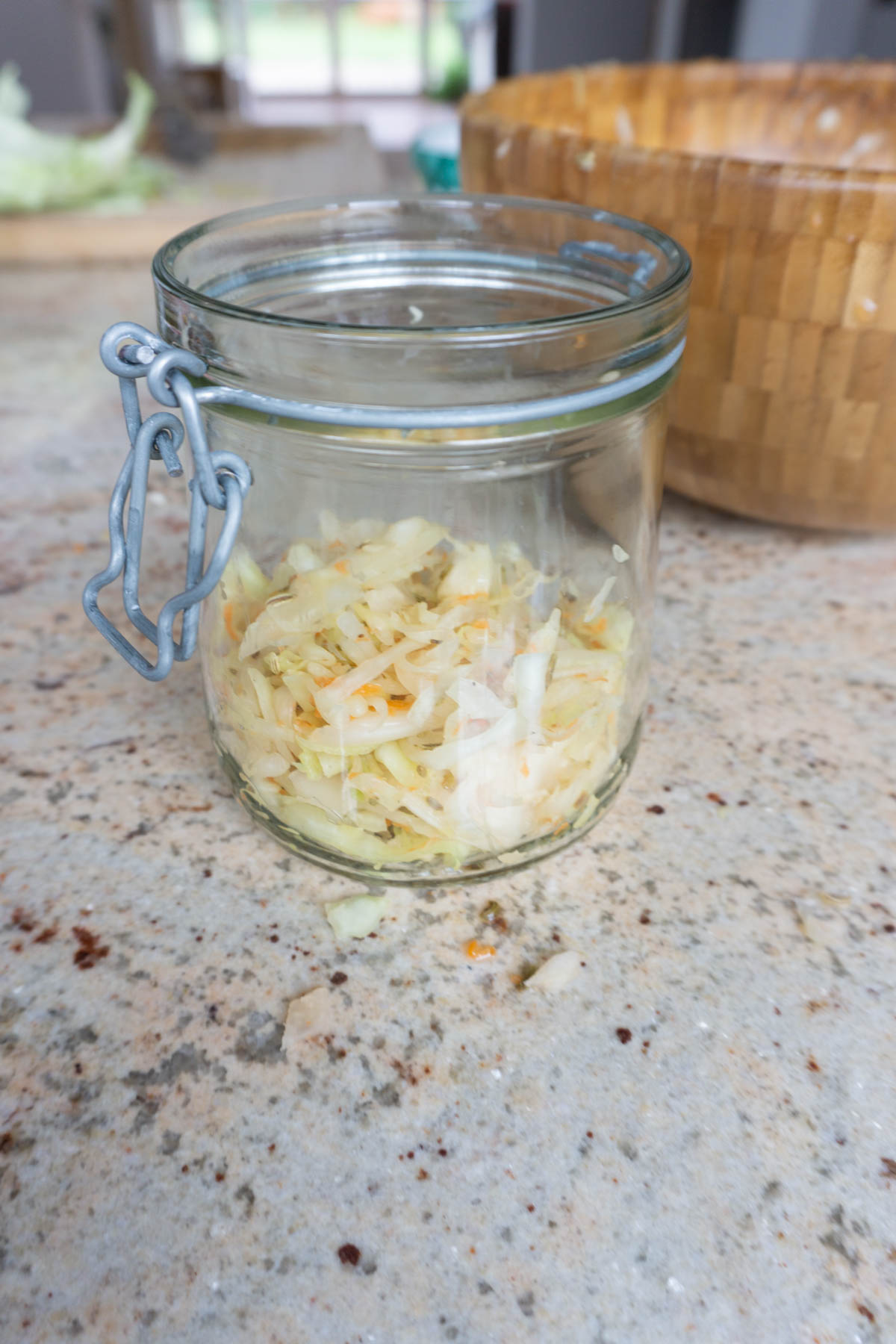
Adding kraut to glass 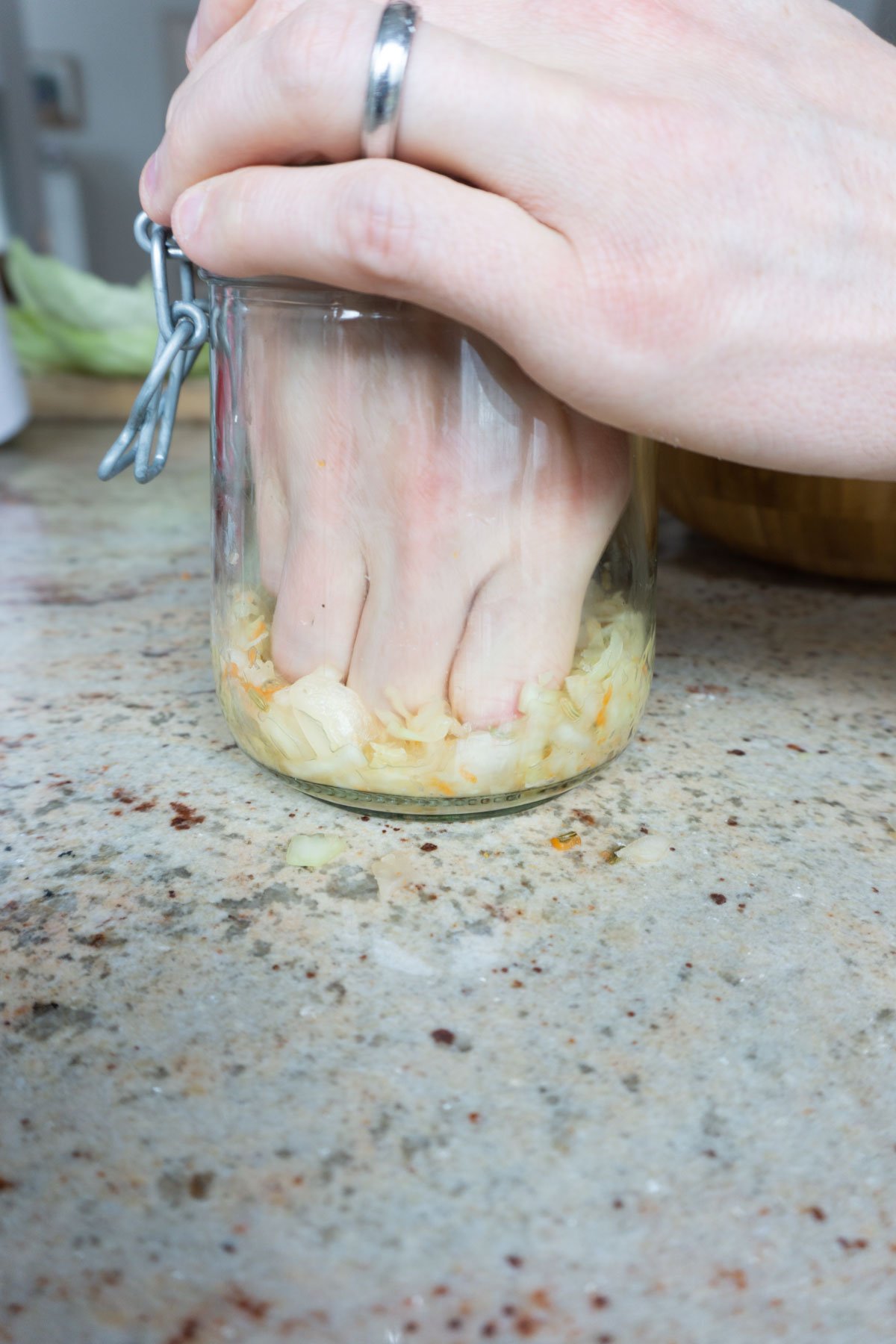
Pushing kraut down in glass 
Adding more kraut to glass 
Pushing kraut down in glass 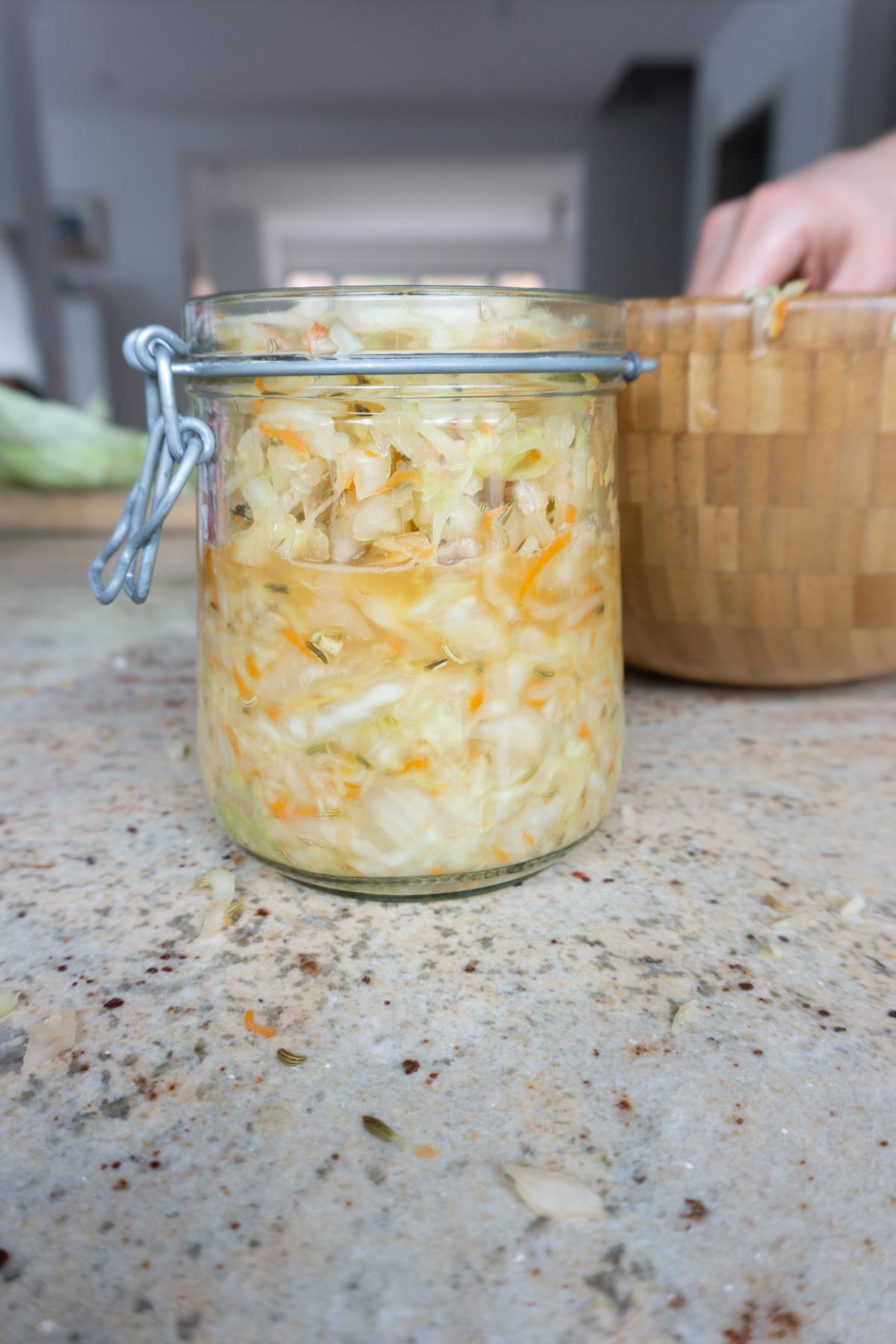
Continuing process until the glass is full 
Kraut looking from above 
Adding cabbage leaves 
Final result – ready for fermentation
How can I adjust this recipe to my dietary requirements?
This recipe is plant-based, vegan, and paleo. There are no dietary changes needed.
And there you have it for this week 🤗. I hope you enjoyed this culinary excursion into easy, plant-based, gut-loving meals (albeit I should stress that all recipes on this blog aim to support this goal 😉) for January. Let me know how you get on with the recipe and I look forward to hearing from you – either in the comments below or over on Instagram under @life_and_lemons_foodblog and with #lifeandlemonsfoodblog.

Homemade Sauerkraut
25
servings30
minutes5 – 10
daysThis homemade, delicious Sauerkraut is an amazing boost for your gut health! With very little effort, you get a jar of goodness that lasts you a long time.
Ingredients
1 large head white cabbage
1 medium-sized carrot
1 – 2 cloves garlic
1 -2 tbsp fennel seeds
1 tbsp salt
- You will also need
Large glass container
Large bowl
Chopping board
Large knife
How to
- Wash glass jar, bowl, chopping board, and knife and dry. This is important as we want to create a good-gut bacteria culture and eliminate the potential for creating mould in the process
- Take off the outer leaves of the cabbage (3 – 4) and leave to one side. Cut the rest of the cabbage very finely and transfer to a bowl. Ensure that you are taking out the stalk and hard bits- because it does not taste nice when biting down on it later
- Grate the carrot and put it into a bowl with the cabbage. Finely grate garlic – or use a garlic press. I found the garlic taste is actually quite mellow – so feel free to go a bit heavy-handed on this. Transfer to the same bowl. Put in fennel seeds to the mix. Depending on how strong you like the anis flavor – again go a bit heavier handed – or not – on it
- Put salt on all ingredients. Massage the cabbage and other ingredients until the cabbage softens and water is pooling at the bottom of the bowl. Once this process has taken place – massage some more (ca. 10 -15 minutes). Every cabbage is different so this will be unique to your own fermentation process
- When cabbage is soft and well mixed through, add to the glass jar. Every three to four handfuls push the cabbage to the bottom of the glass jar. The cabbage should be packed tight and the water from the bowl should completely cover the cabbage
- When you have left about 3 – 4 cm to the lid, fold the cabbage leaves and place them tightly on the top of the kraut and push the cabbage further down (your hand should be wet from the process and water almost pooling out of the jar).
- Seal lid and place in a bowl (in case liquid escapes you do not have it all over the counter – trust me I have been there it is a greatly recommended step!) letting it sit in your cabinet (preferably dark) at room temperature.
- Release the air every 1 -2 days (depending on how warm it is – might also be twice a day). The kraut should become good after ca. 7 – 10 days. The longer you leave it the stronger the taste will be. An earlier end date will result in a more mild taste
- Once your fermentation process is done and you decide the Kraut is to your liking – place in the fridge – removing and discarding the cabbage leaves first. This jar of deliciousness will last you quite a long time but there are a few recommendations to ensure this: 1. Be sure to always use a clean fork when taking kraut out of the jar. 2. Trust your “smell-buds” you will smell should the Kraut have gone bad (and hence it should then be thrown out). ENJOY!!


